The Orange Park Library- A 50th Anniversary History
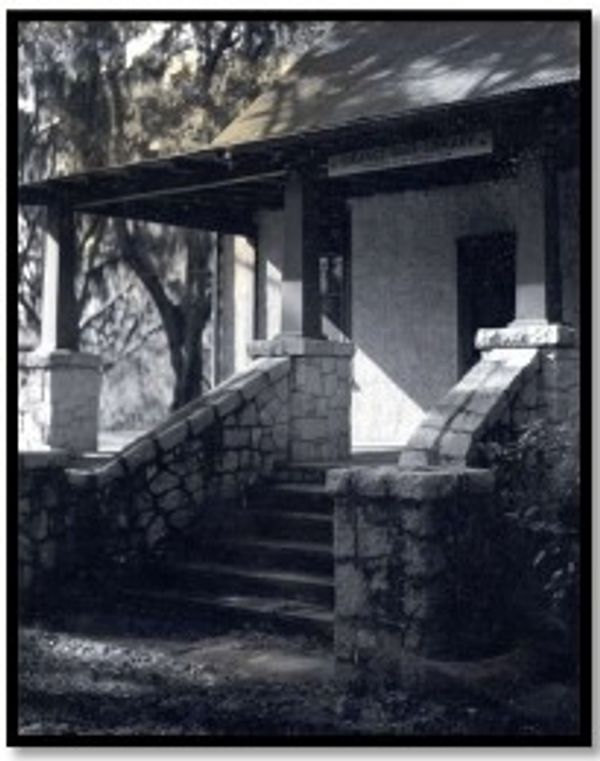
The story of the Orange Park Library begins in 1911, when the Orange Park Woman’s Club transformed a small wooden schoolhouse at the corner of Reid and McIntosh into the town’s first lending library. With donated books placed on simple shelves, the women of the club created a space where both children and adults could borrow reading materials.
By 1930, the Woman’s Club had moved the library into their own clubhouse, continuing to operate it as volunteers. As Orange Park grew, so did the library’s needs, and in 1949 the collection was relocated to a new site at the corner of Kingsley Avenue and U.S. 17, placing it closer to the town’s developing social and governmental hub.
In 1958, improvements were made to the Kingsley Avenue building, and by that time the library held 1,500 books, a sign of steady growth. Just five years later, in April 1963, the aging structure was replaced with a striking new “Butterfly” style building, opening with 3,000 books and allowing more services. Shortly after this move, the Friends of the Orange Park Library formed, establishing a support organization that continues to act as a community advocacy group today.
As the town continued to expand in the 1970s, plans for a larger, more permanent library took shape. In 1974, architect JeƯrey Schafer presented a proposed design for a new library in Town Hall Park, but the town council ultimately chose a diƯerent location. Two years later, in 1976, Orange Park celebrated the opening of its new library building and the branch still serves the community today. Local oƯicials, Friends of the Library members, and families gathered for the dedication, where a ribbon was cut, symbolizing the library’s transition from temporary bookmobile service to a fully modern public facility.
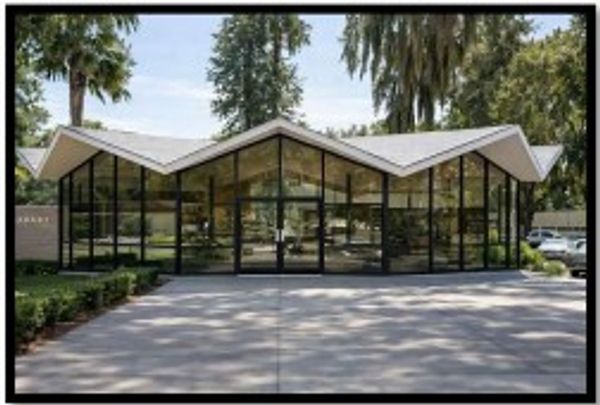
The library continued to evolve with Orange Park’s population. In 1996, a major renovation and expansion, nearly $2 million in scope, integrated the existing 8,000-square-foot brick-clad structure with a 21,000-square-foot addition. This project added new entrances, a dedicated children’s wing with a story room, quiet study areas, improved circulation flow, and updated furnishings, transforming the library into a spacious, modern facility designed to meet the needs of a rapidly growing town.
From a one-room schoolhouse to a major public institution, the library’s history reflects the story of Orange Park itself — a community continually investing in learning, connection, and the shared value of public gathering space.
ORANGE PARK MEMORIES -ORANGE PARK CATHOLIC HISTORY
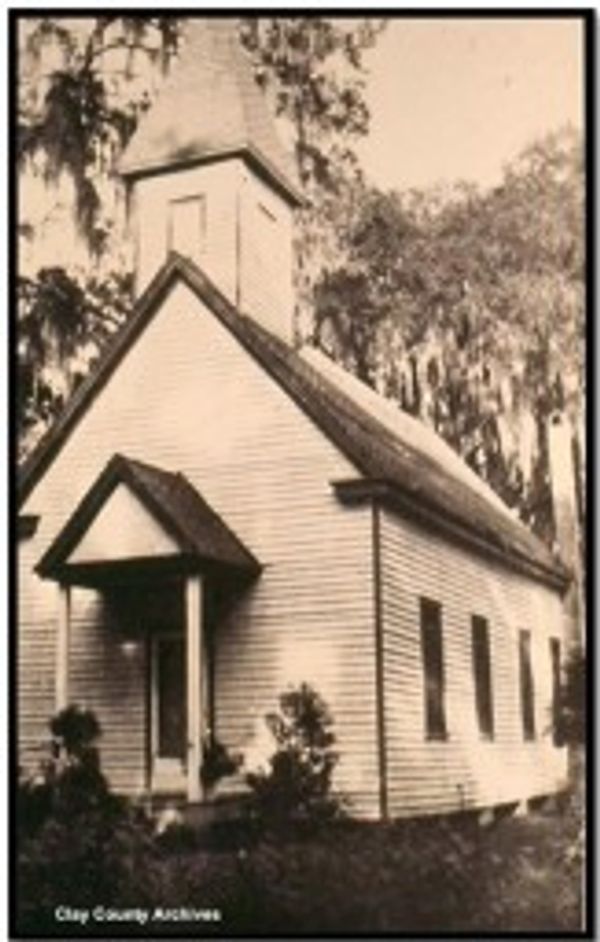
Catholic life in Orange Park began quietly in 1877, when the Diocese of St. Augustine built the first recorded St. Catherine’s Catholic Church, a small wooden structure at the NE corner of Reed St. and Stowe Ave. designed for just 54 people and operated under Immaculate Conception in Jacksonville. For decades the building had no electricity; and a wood stove was its only utility. Meanwhile in Jacksonville, starting in 1886, Sister Mary Ann, of the Sisters of St. Joseph, who was remembered as the “Angel of Mercy, “opened St. Mary’s Home for orphans on Ocean Street. The need was so great that a larger building rose in 1890, followed by a new wing in 1899. Disaster struck in 1901 when the Great Fire destroyed the home, but the benefactors of the Sisters rebuilt the following year at 427 Ocean Street, continuing their work with new energy. The plumbing for this 3-story building was provided by William Clarke, father-in-law of Orange Park’s Carrie Clarke. Over time, the Sisters expanded beyond the city. In 1917, they purchased a summer home at Pablo Beach, where children stayed until 1926. At the same time, Orange Park’s Catholic population was slowly increasing, especially after Moosehaven opened in 1922. Early residents often traveled to Jacksonville for Mass. By 1924, Father James Meehan was ministering to the small but growing St. Catherine’s community.
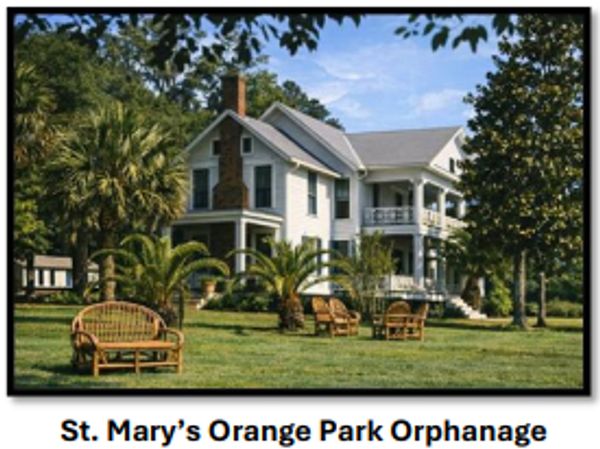
A major turning point came in 1930, when newspapers announced that the Catholic Church had purchased the Appleby estate in Orange Park, 19 acres stretching from the St. Johns River to the Atlantic Coast Line Railroad. The $16,000 property included a large house that was quickly remodeled and expanded into a summer home for the children of St. Mary’s. Plans called for a dormitory to house 90 children immediately, with capacity for 200 the following year. Children under 3 years old would remain in Jacksonville, while older children would spend their summers in Orange Park. By 1943, the estate featured dormitories, a dining hall, a swimming pool, a pavilion, and wide open play areas. Younger girls crafted artwork, while teenage girls studied business courses to prepare for their futures.
To support both the children and the growing Catholic community, a small wooden chapel was built on Blake Avenue. It became a place for Mass, catechism, and quiet reflection. Bishop Patrick Barry had used his own personal funds to finance the construction of the chapel. Ironically, the first major mass held in 1940, Bishop Barry’s own funeral Mass. By the 1950s, St. Catherine’s Mission had outgrown its early structures. From 1952 to 1970, “Barry’s Chapel” served as the parish church, hosting weddings, funerals, bazaars, and community gatherings. Newspaper notices from 1970 show Masses split between the Blake Avenue chapel and S. Bryan Jennings School, as the parish that had grown to more than 250 families. That same year, Father Edward Rooney became pastor, and under his leadership St. Catherine’s Mission was officially reclassified to parish status. Plans for a new church on Kingsley Avenue moved quickly; and the new St. Catherine’s Church was dedicated on September 26, 1971.
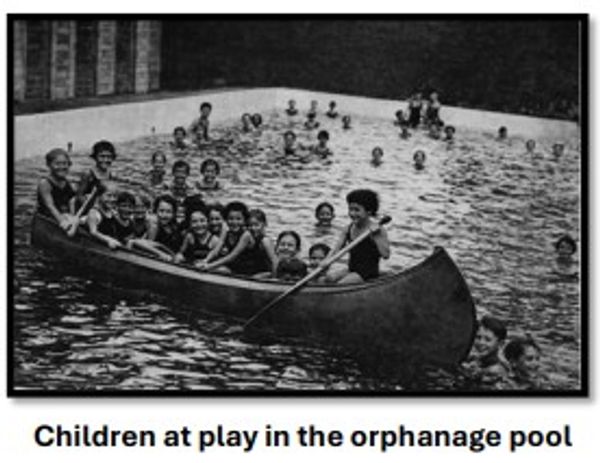
While the parish flourished, the Sisters’ era in Orange Park was ending. By 1965–66, St. Mary’s Home in Jacksonville had closed, and the Sisters no longer used the Orange Park property. Title passed to the Diocese of St. Augustine, and the once-busy Blake Avenue chapel entered a period of uncertainty. In the early 1970s, a judo business met there illegally and in 1973, the Heritage Christian Academy occupied the site without permission in 1975. A lengthy zoning battle followed, culminating in a 1977 court ruling requiring Heritage Christian Academy to close because it had never obtained the zoning exception required for schools and churches in residential neighborhoods. With the property abandoned and the chapel no longer needed, the Diocese deconsecrated the building. Thanks to the generosity of Virginia Mims, owner of the Village Nursery, the chapel was donated to the Orange Park Community Theater. In 1987, the small wooden church was lifted onto a flatbed truck and moved to the corner of Bolton and Filmore Streets, where it was transformed into a performance space. The theater opened its first season in the renovated chapel that same year.
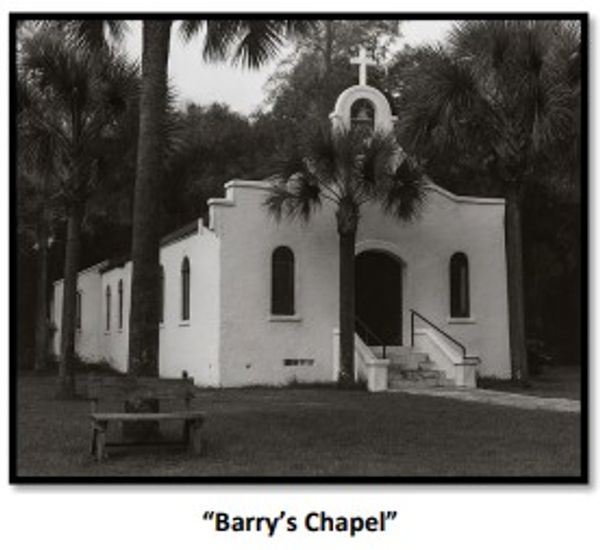
Today, the corner of Blake and River Road bears no memory of the St. Mary’s Summer Home for Orphaned Girls. The original chapel site on Blake Avenue is a quiet residential lot. No trace remains of the sanctuary where generations of children played, where Moosehaven residents attended Mass, where parishioners celebrated sacraments, and where the Sisters of St. Joseph nurtured hundreds of young lives. It is fitting to bring this story back to Orange Park. The story is a reminder of our capacity to care for one another .
Veterans Day Observance
On November 11, 2011, the Historical Society of Orange Park conducted a groundbreaking ceremony for a new Veterans Memorial at Magnolia Cemetery. One year later, with the generous support of the community and the Town of Orange Park, we dedicated the new memorial. Each year on November 11th, the Society hosts a Veterans Day ceremony to honor our service members and the important role they play in our lives. Since 2013, the Society has also sponsored an essay contest in conjunction with the Veterans Day ceremony. Please visit our Veterans Memorial Page to learn more about the memorial, our annual ceremony and our essay contest.

Hometown Holiday
In December the 100-year-old Clarke House is open for tours decorated in circa 1920-style. Guests learn about the early residents of Orange Park and local celebrities as historical re-enactors, stationed inside and around the Clarke House in period clothes, tell their stories. The Town of Orange Park offers festive lights throughout Clarke House Park to give it the added sparkle of the season. A shopping village, entertainment and activities for children are all on hand for a true community holiday celebration.

ORANGE PARK MEMORIES - TEA HOUSE

The Historical Society is highlighting Orange Park’s historic houses each month of 2026. This month we feature the Tea House at 167 Stiles Ave, built in 1925. This Colonial Revival house was for Mr. and Mrs. C.F. Knight. (a former mayor of Orange Park). It originally was a three-bedroom house with a sleeping porch on the east side of the house. Finley and Iola Knight brought their two children, Doris and Finley Jr., from Mandarin to Orange Park in 1924. Iola was already a success with the Robinwood Grill, and so, opened a tearoom in their new home in Orange Park. The 11‑room English bungalow of brown‑stained shingles was large enough for a family with teenagers. It was not long before the house was known simply as Robinwood. One 1927 article describes the scene: “Many congenial parties took advantage of the ideal Florida weather, motoring to Orange Park and entertaining their friends at this charming place.” Finley Knight had an active civic life. He served Orange Park as commissioner, clerk, tax assessor, treasurer, and eventually mayor. In 1933 he became president of the Jacksonville Rotary Club. Iola, born in Bermuda, was a member of the Jacksonville chapter of the Daughters of the British Empire, and belonged to church and garden circles in addition to her running the Tea Room. Findley and Iola both died in the early 1930s.
In an odd coincidence, two men who later lived at the home were Cecil Field pilots who had crashes while living at 167 Stiles. Commander Geoffrey B. King, Jr. attached to the USS Saratoga, died when his jet
crashed at sea in 1959. Cmdr. John C Christenssen crashed, but survived, the following year when his nose wheel collapsed while landing at Cecil Field in 1960.
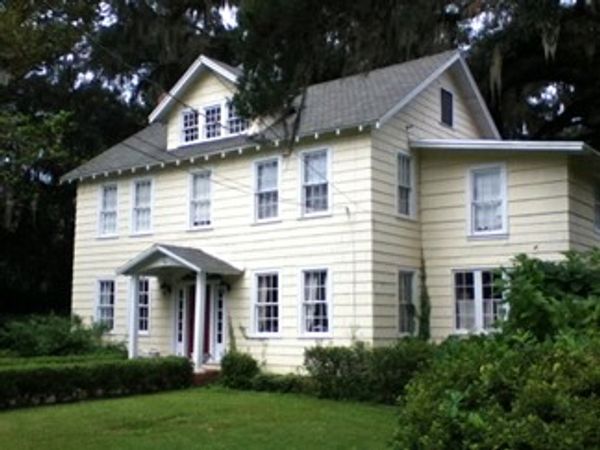
There are gaps in the ownership chain. The house became home again when Joe and Mary Ellen DeMarco found it and restored it. The Knights would be very pleased with the results. The DeMarcos have invested countless hours preserving it with a careful eye on its history. The Knight home rested on a raised pier-and-beam foundation, with original wood windows and cedar shingles that remained intact for decades. When Joe and Mary Ellen DeMarco purchased the house in 1996, their restoration work revealed the home’s original materials and finishes. Cedar shingles were buried beneath layers of gray, gold, and blue paint. The original windows; and the 1920s electrical and plumbing that remained kept the home’s historic footprint and character intact. It was a long process of bringing it back to life. The DeMarcos started with only a couple of usable rooms, living in the middle of a restoration. They rebuilt footings, scraped away paint, upgraded wiring and plumbing, refurbished bathrooms, and painted every room. It continues to be a source of projects and preservation.
by Cindy Cheatwood